


The CDC publishes baby milestone checklists for 2, 4, 6, 9 and 12 months, the same ages as the AAP's well-child visits. Each one lists what most babies do by that age, across four areas, like smiling at you by 2 months, laughing by 6 months, sitting without support by 9 months and pulling up to stand by 1 year. The simplest way to remember them is to write the date next to the milestone the day it happens, and take a photo, which keeps the date for you.
This post is a keepsake guide, not a screening tool. Every baby reaches these at their own pace. If you have a concern about your baby's development, talk with your child's doctor.
What are the baby milestones by month?
The CDC's milestone checklists cover 2, 4, 6, 9 and 12 months in the first year. Each one groups milestones into social, language, thinking and movement. The list below uses the CDC's own wording from those pages, which we checked on 22 Oct 2026. The CDC places each milestone at the age by which at least 75% of children are expected to do it, so plenty of babies do these later.
By 2 months. From the 2-month checklist.
- Social. "Looks at your face" and "Smiles when you talk to or smile at her."
- Language. "Makes sounds other than crying."
- Thinking. "Watches you as you move."
- Movement. "Holds head up when on tummy."
By 4 months. From the 4-month checklist.
- Social. "Chuckles (not yet a full laugh) when you try to make him laugh."
- Language. "Makes sounds like 'oooo', 'aahh' (cooing)."
- Thinking. "Looks at her hands with interest."
- Movement. "Holds head steady without support when you are holding him" and "Brings hands to mouth."
By 6 months. From the 6-month checklist.
- Social. "Knows familiar people" and "Laughs."
- Language. "Takes turns making sounds with you" and "Blows 'raspberries'."
- Thinking. "Reaches to grab a toy she wants."
- Movement. "Rolls from tummy to back."
By 9 months. From the 9-month checklist.
- Social. "Looks when you call her name" and "Smiles or laughs when you play peek-a-boo."
- Language. "Makes a lot of different sounds like 'mamamama' and 'bababababa'" and "Lifts arms up to be picked up."
- Thinking. "Looks for objects when dropped out of sight" and "Bangs two things together."
- Movement. "Sits without support" and "Moves things from one hand to her other hand."
By 1 year. From the 1-year checklist.
- Social. "Plays games with you, like pat-a-cake."
- Language. "Waves 'bye-bye'" and "Calls a parent 'mama' or 'dada' or another special name."
- Thinking. "Looks for things he sees you hide, like a toy under a blanket."
- Movement. "Pulls up to stand" and "Walks, holding on to furniture."
First steps and first words come after the first birthday on the CDC's lists. Our baby firsts list covers those, plus the firsts with no set age, like the first bath, haircut and trip.
Why are the checklists at 2, 4, 6, 9 and 12 months?
Those are the ages the CDC chose for its checklists, and they match the AAP's schedule of well-child visits, which lists visits at 1, 2, 4, 6, 9, 12, 15 and 18 months and 2 years. So each checklist lands at an appointment where you can raise anything you've noticed.
Month-by-month guides that list something for months 3, 5, 7, 8, 10 and 11 are filling in between the checklists. That's fine as a rough picture. It isn't something to measure your baby against.
What if your baby isn't doing these yet?
A milestone that comes later than the list is common, and the list isn't a test. The CDC says its milestones should not be used as screening or diagnostic tools to detect developmental delays.
The CDC's advice on each checklist, such as the 2-month page, is to "talk with your child's doctor, share your concerns, and ask about developmental screening." You know your child best, and you don't need to wait for the next visit to ask.
How do you remember baby milestones?
Write the date the same day, in the place you already look. It's easy to remember that something happened and lose the date by the time you sit down with a baby book. Five habits cover it.
- Keep one note on your phone. Call it "Milestones" and add a line with the date each time. A line a month is enough.
- Take the photo or a ten-second video. Your phone stores the date with it, so even without a note you can find the week it happened. The clip of the first babble keeps something a note can't.
- Text the other parent. It gives you a second record and a timestamp.
- Use the well visit as a catch-up. The night before each appointment, scroll through that stretch of photos and add anything you missed. The checklist age and the visit age line up, so this takes a few minutes.
- Keep tracking and keeping apart. If you want to track milestones against the CDC's lists, the CDC offers a Milestone Tracker app for that. Your own note is for the details the checklist doesn't ask about, like where you were and who laughed first.
For what to write beyond the date, our post on what to write in a baby book has prompts for each month.
Can an app keep the dates for you?
Partly. A photo already carries its date, so a baby book app that sorts your photos by month and shows your baby's age gives you the timeline without typing. Marking the milestone is still up to you.
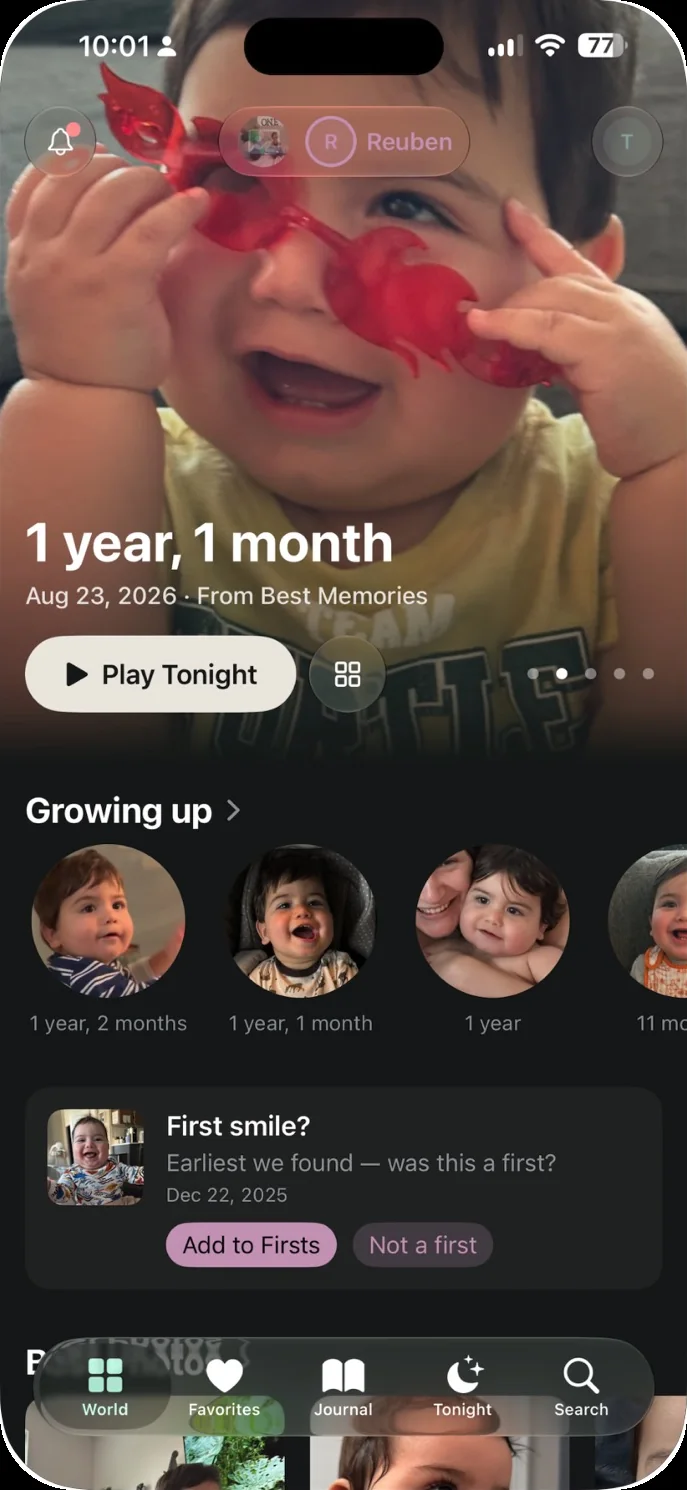
The app we make: Our Little World is a private baby book app for iPhone and iPad. It finds your child in the photos already on your iPhone and lays them out month by month, with their age on each photo. You can mark a First on the photo it belongs to, and the app can suggest a possible First it found in your photos and notes, which is kept only if you add it. Letters and Firsts stay on your phone. It isn't for Android users, for families who want a printed book, or for anyone who needs a free plan. You can read more about it for your baby's first year.