
Your child won't remember most of this year, so the record is up to you. A review of memory research puts the average earliest memory among adults in Western countries at 3 to 4 years.
What should you write in a baby book?
Most baby books ask for dates and measurements. Those are easy to find later in your photos and your pediatrician's records. The details that disappear are the ones nobody writes down.
- The sounds. The squeal, the fake cough, the babble that sounded like a word.
- The names. Every nickname and how it started.
- The routines. How bedtime went, the song that worked, the walk you took every afternoon.
- The opinions. The food they spat out, the toy they wanted, the person who could always get a smile.
- The story behind a First. Where you were, who saw it, and what everyone did next. The date matters less than the scene.
- How you felt. One honest line about what being their parent was like that month.
Write in your own voice, even in a sentence or two. A short note in your handwriting or your words will mean more later than a perfect paragraph.
What to write in a baby book, month by month
Use these as prompts, not a checklist. Skip anything that doesn't fit your baby. Every child moves at their own pace, and a baby book is not a development report. If you have questions about how your baby is growing, ask your pediatrician.
Month 1. The birth story, in whatever detail you want your child to read one day. Why you chose their name. Who came to meet them. How they liked to be held, and what the nights were like.
Month 2. The first real smile, and who got it. The CDC lists smiling when you talk to or smile at them among the things most babies do by 2 months. Write down what you were doing when it happened.
Month 3. The sounds they started making. What they stared at. Whether tummy time was a fight.
Month 4. The first chuckle. By 4 months, most babies chuckle when you try to make them laugh, according to the CDC. Write down exactly what you did to get it. Silly faces, a sneeze, the dog.
Month 5. What their hands were busy with. Their feet, your hair, your glasses. The toy that went everywhere.
Month 6. First foods and the faces that came with them. The CDC's 6-month list includes blowing raspberries and squealing. If your baby has a signature noise, describe it as best you can, or record it.
Months 7 and 8. How they got around, whether that was rolling, scooting or crawling backwards. Who they reached for. The first time they seemed shy with someone new.
Month 9. Peekaboo, and the babble that started to sound like "mama" or "dada." Both appear on the CDC's 9-month list. Note who your baby looked at when they said it.
Months 10 and 11. What they pulled themselves up on. The game they wanted to play again and again. Their favorite book, and the page they always turned to.
Month 12. Waving bye-bye, calling you by name, cruising along the couch. The CDC lists these by 1 year. Then write about the first birthday, who was there, and what you would tell your child about their first year if they asked tomorrow.
What if you have fallen behind?
Most parents fall behind. The book stays blank after month three, and that's normal.
You can catch up from your camera roll. Scroll back one month at a time. The photos will remind you of the high chair, the first trip to the park, the week of the ear infection. Your messages help too. Search the texts you sent your partner or your parents for words like "first," "tooth" or "today."
Then write one moment for each month. Not a summary, just one scene, anchored to one photo. Twelve short entries is a finished first year.
If the photos themselves feel out of control, our post on how many photos parents take in the first year covers why the camera roll fills up so fast.
What can you leave out?
Leave out anything that makes the book feel like homework. Some baby books ask for a favorite song, book and toy every single month. Many babies don't have one yet, and a blank line doesn't mean you missed something.
If the birth was hard, you can write a short, true version now and add more later, or leave that page alone. Write what you would want your child to read when they are grown.
How to keep a baby book that keeps up with you
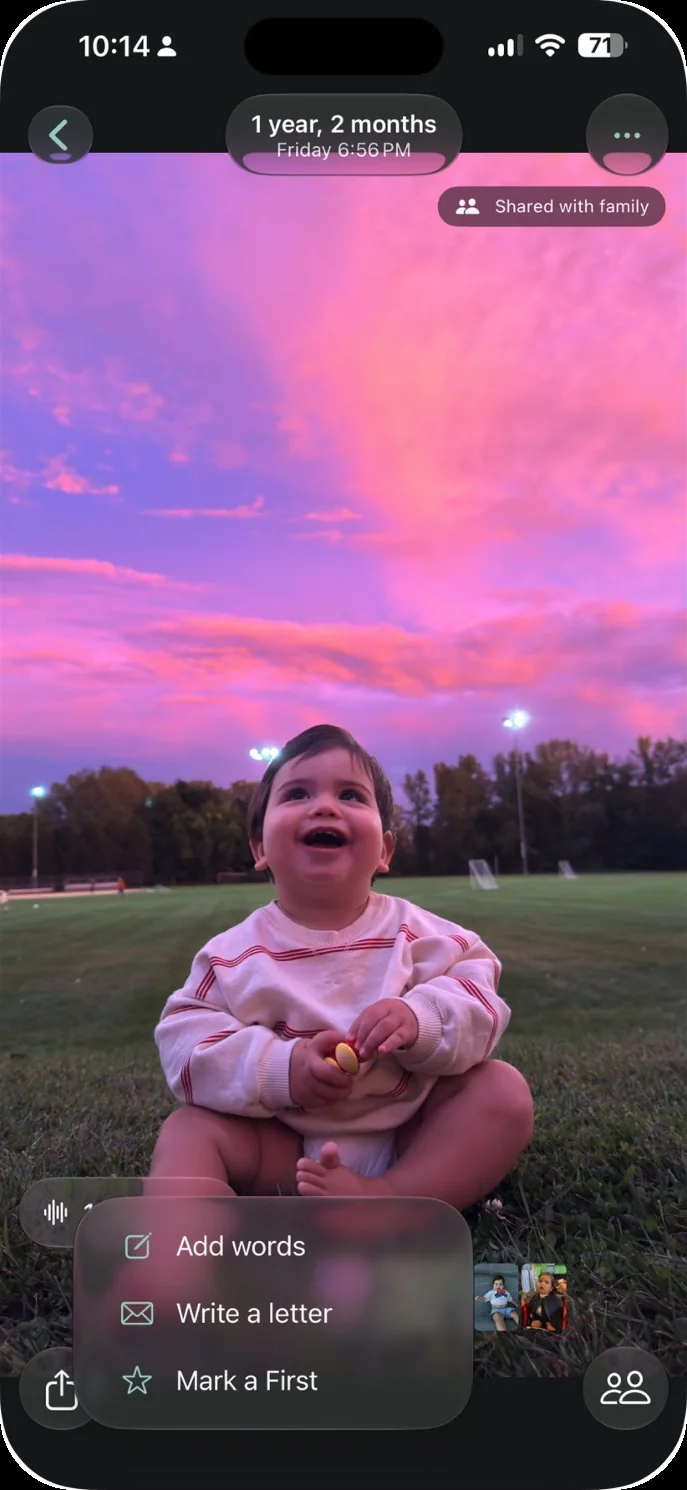
The hardest part of a paper baby book is that the writing and the photos live in different places. You have the photo of the first chuckle on your phone and no pen nearby.
Our Little World is a private baby book app for iOS. It finds your child in the photos on your iPhone and lays out their life month by month, with their age on every photo. You can add a few words, a voice note, a letter for later, or mark a First right on the photo it belongs to. Both parents share one family space and can write in their own words, and your originals stay in Apple Photos. You can read more about using it as a baby journal.
Our Little World is on the App Store. Everything is free for 7 days on monthly or 14 days on yearly. Download it on the App Store.