
The baby firsts worth writing down are the first smile, laugh, foods, words and steps, plus firsts with no set age, like the first haircut, trip and holiday, and small everyday ones only your family notices. For each, note the date, who was there and one detail. Every baby reaches these at their own pace.
This is a keepsake list, not a development checklist. The ages below come from the CDC's milestone pages and only show when most babies do something. If you're worried about how your baby is developing, talk to your child's doctor.
Which baby firsts should you write down?
Write down any first you'd want to read about in 20 years. The big ones are easy to remember. The small ones are easier to lose. Use this checklist and skip anything that doesn't fit your family.
The big firsts
- First smile at you
- First laugh
- First time rolling over
- First time sitting up alone
- First solid food, and whether it stayed in
- First tooth
- First "mama," "dada" or name for you
- First wave bye-bye
- First steps
- First word that isn't a name
- First two words together
Firsts with no typical age
- First night home
- First bath
- First time meeting each grandparent
- First walk outside
- First time someone else babysat
- First haircut, and whether you kept a curl
- First trip, and how the car ride or flight went
- First holiday, and who held them for the photo
- First birthday
- First time at the beach, in the snow or in a pool
- First day of daycare
- First time sick, and who stayed home
Small everyday firsts
- First time they reached for you
- First time they fell asleep on someone other than a parent
- First time they noticed the dog or cat
- First favorite book
- First time they shook their head no
- First thing they were scared of
- First joke, even if only they got it
- First time they asked for a song again
At what age do babies reach the big firsts?
The CDC's milestone pages place the big firsts between 2 months and 2 years old. The CDC puts each milestone at the age by which at least 75% of children are expected to show it, so some children will do these things later than the age shown. The table uses the CDC's own wording from its milestone pages, which we checked on 16 Oct 2026.
| First | CDC's wording | Most babies do this by |
|---|---|---|
| First smile at you | "Smiles when you talk to or smile at her" | 2 months |
| First chuckle | "Chuckles (not yet a full laugh) when you try to make him laugh" | 4 months |
| First cooing | "Makes sounds like 'oooo', 'aahh' (cooing)" | 4 months |
| First real laugh | "Laughs" | 6 months |
| First raspberries | "Blows 'raspberries' (sticks tongue out and blows)" | 6 months |
| First roll | "Rolls from tummy to back" | 6 months |
| Sitting up alone | "Sits without support" | 9 months |
| First babble | "Makes a lot of different sounds like 'mamamama' and 'bababababa'" | 9 months |
| Arms up to be held | "Lifts arms up to be picked up" | 9 months |
| First wave | "Waves 'bye-bye'" | 1 year |
| First "mama" or "dada" | "Calls a parent 'mama' or 'dada' or another special name" | 1 year |
| Pulling up and cruising | "Pulls up to stand" and "Walks, holding on to furniture" | 1 year |
| First steps | "Takes a few steps on his own" | 15 months |
| First words | "Tries to say one or two words besides 'mama' or 'dada'" | 15 months |
| Walking alone | "Walks without holding on to anyone or anything" | 18 months |
| First scribble | "Scribbles" | 18 months |
| First two-word phrase | "Says at least two words together, like 'More milk.'" | 2 years |
| First kick of a ball | "Kicks a ball" | 2 years |
The CDC doesn't list an age for a first tooth, first foods, a first haircut or the other firsts on this page, so we don't either.
What if your baby hasn't reached a first yet?
Every baby is different, and a first that comes later than the table isn't something to record as a miss. The CDC says its milestones should not be used as screening or diagnostic tools, and this list isn't one either.
If something worries you, ask your child's doctor. The CDC's advice on its milestone pages, such as the 2-month checklist, is to "talk with your child's doctor, share your concerns, and ask about developmental screening."
What should you write down for each first?
Write the date, your baby's age, where you were and who saw it. Then add one detail you'd lose otherwise, like the sound they made or what happened right after.
The tries before a first are worth a line too. The week of wobbling before the first step, or the "ba" that came before "ball," is often a better story than the day itself. If you have a video, note what's in it so you can find it later.
You don't need to write much. A first written down the same day, in one or two sentences, is enough. For longer prompts by month, see our post on what to write in a baby book. And if you want to tell your child about their first year in your own words, our guide to writing a first birthday letter has examples.
How do you keep track of baby firsts when you're busy?
Keep the list where you already are, which for most parents is their phone. Here are five ways to do it.
- Start one note called "Firsts." Add a line with the date each time something happens.
- Take the photo or video. Your iPhone saves the date with it, so you can look it up later.
- Favorite it right away. Tap the heart in Photos so the moment is easy to find. Our guide to organizing baby photos on iPhone covers albums and search.
- Tell the other parent. Text them the date, which also gives you a second record.
- Catch up once a month. Scroll back through the month's photos and add any firsts you missed.
If you prefer paper, tape a printed copy of the checklist above inside a cupboard door and write the date next to each first as it happens.
Can an app keep track of baby firsts for you?
Yes. Some baby book apps let you mark a First on a photo, so the date and your baby's age stay with it. That saves you from writing the date by hand.
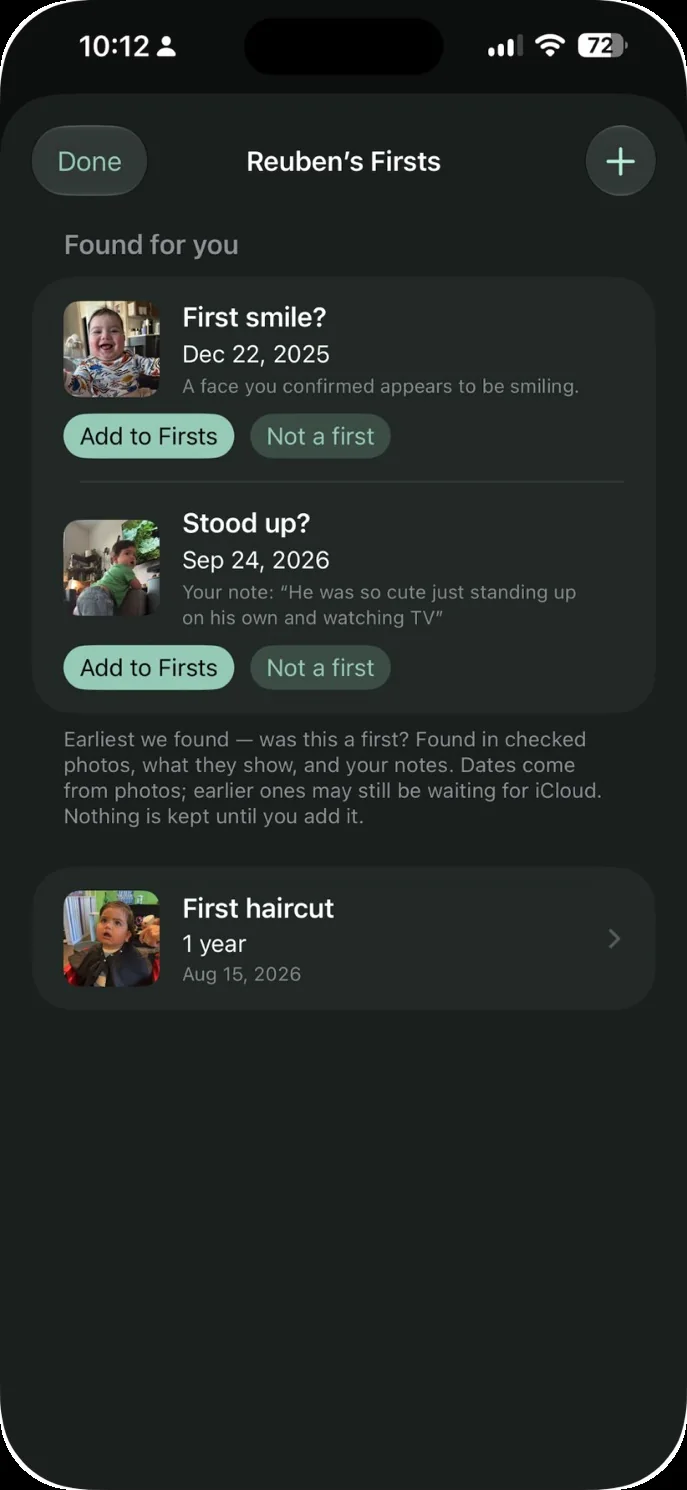
The app we make: Our Little World is a private baby book app for iPhone and iPad. Our Little World finds your child in the photos on your iPhone and lays them out month by month. You can mark a First on the photo it belongs to, and Our Little World can suggest a possible First it found in your photos and notes, like a first smile, which is kept only if you add it. Letters and Firsts stay on your phone. Our Little World isn't for Android users, for families who want a printed book, or for anyone who needs a free plan. You can read more about it for your baby's first year.