
There's no single right answer, and the American Academy of Pediatrics says so. The main risks of posting a baby publicly are location details, strangers reusing photos, and a record your child didn't choose. Many parents take a middle path, with a small audience, no face or location, or a private album for family.
Below are the risks the evidence supports, what children say later, and the middle paths many parents use. We checked every source on 16 Oct 2026.
What is sharenting?
Sharenting is the practice of parents posting photos, videos and information about their children on social media, as the American Psychiatric Association (APA) defines it. It's common. In a 2025 Ipsos survey of 1,028 parents in Ireland and 1,019 in France for Ireland's Data Protection Commission and France's CNIL, published in June 2026, around 3 in 4 parents had shared content about their children online in the past year, counting messaging apps like WhatsApp, mostly to stay connected and keep a family record.
For more numbers, with the sample and year for each, see our page of sharenting statistics.
What are the real risks of posting baby photos?
The real risks come mostly from public posts and from details you didn't mean to share. The American Academy of Pediatrics (AAP) says there is no one right answer on whether to post, and that sharing with a public audience can create risks like unwanted contact. These are the main risks the AAP and others name.
- Location and routine. The AAP lists unintentionally sharing location or daily routines among the privacy risks. Apple says a photo you share includes its metadata, such as location, unless you turn it off.
- Photos reused by strangers. The CNIL says photos on social networks can be hijacked by ill-intended individuals, and it strongly advises against sharing children's photos on social networks, especially from a public profile.
- AI edits. The AAP warns that generative AI can be used to alter family photos, including to create sexually exploitative images of real children. Parents in the DPC and CNIL survey named AI and deepfakes as their second biggest worry, after misuse by strangers.
- Permanence. An AAP article on HealthyChildren.org says nothing online is completely private, and everything is permanent. Screenshots get around privacy settings, and deleting a post doesn't recall copies.
- A digital footprint your child didn't choose. A 2026 commentary in the journal Psychiatric Services, summarized by the APA, lists a permanent digital footprint, strained family relationships and image misuse among the possible effects.
The AAP says these risks apply especially when content is publicly accessible. Each middle path below narrows who can see a photo.
What do children say about it later?
Children tend to want more say than parents give them. In a University of Michigan study presented at CHI 2017, which surveyed 331 parent and child pairs in the US with children aged 10 to 17, children believed parents should ask permission more often than parents thought they should. Children were fine with flattering, positive photos. When they described what they didn't want posted, they often named photos, including "embarrassing photos" and "baby photos."
Some parents come to regret it. In the 2025 DPC and CNIL survey, 15% of 773 Irish and 14% of 729 French sharing parents said so. Our sharenting statistics page has the rest of that survey.
A baby can't be asked. The Psychiatric Services authors suggest asking instead whether your child would likely object to the post at 16.
Does hiding your baby's face make a post safe?
Hiding the face lowers the risk, but it doesn't remove it. The AAP and the CNIL both suggest covering a child's face with an emoji, blurring it, or photographing a hand or the back of the head. The rest of the photo can still give things away. Google notes that even when location data is removed, people may guess a location from landmarks in a photo. A full name, a birth date, a nursery sign or the front of your house can identify a child without a face.
What are the middle paths between posting and not posting?
Most parents land somewhere in between. Each of these options narrows who sees a photo or what it reveals.
- Share with close friends only. Instagram lets you share reels with a Close Friends list instead of all followers, and the AAP suggests the same list for stories. Facebook's audience selector has a Custom option for sharing with specific people or friend lists, and Custom also lets you untick Friends of those tagged so a post doesn't spread to their friends.
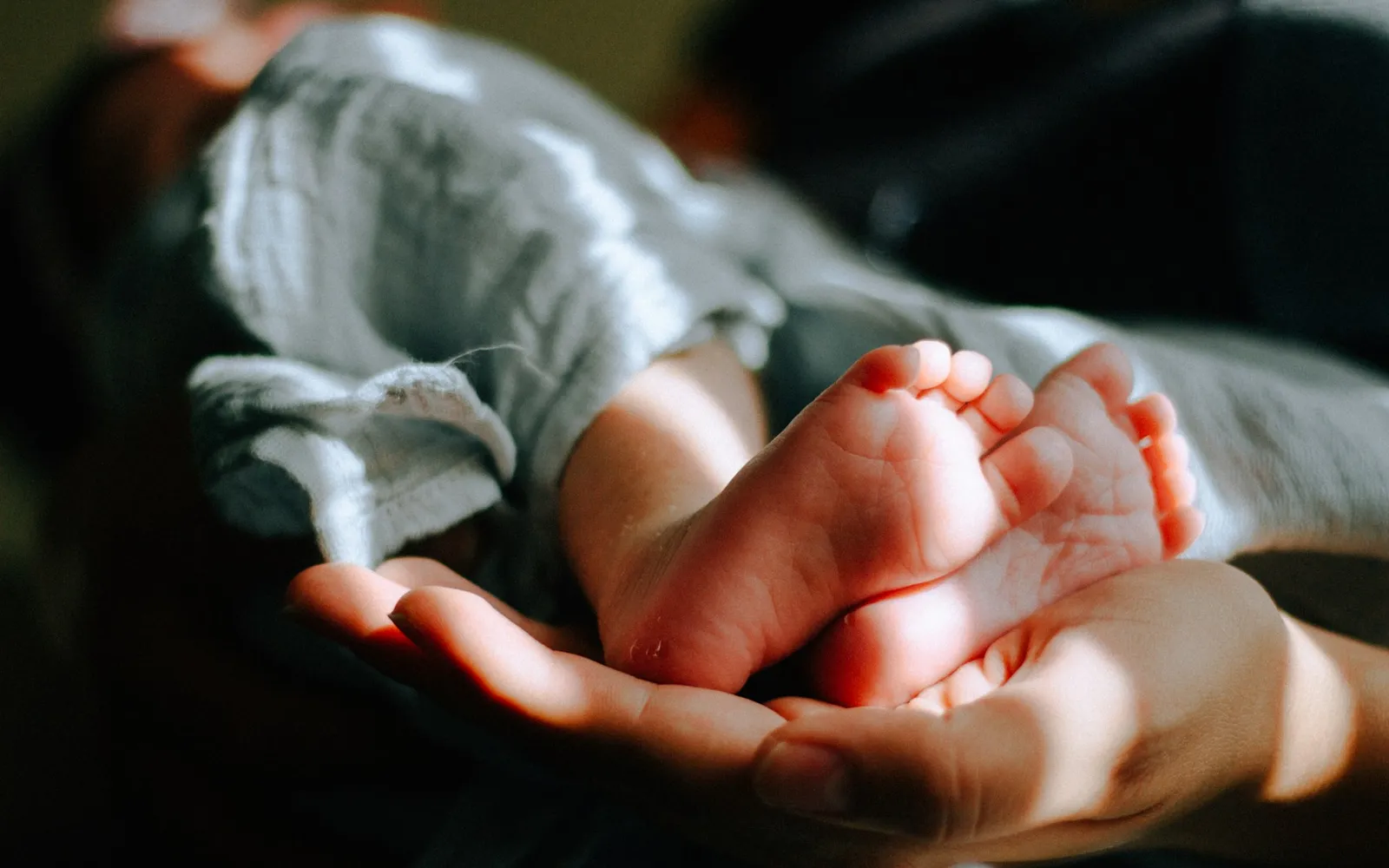
- Post without the face. Hands, feet, the back of a head, or a photo taken from a distance.
- Post without the location. Turn off location in the share sheet before you share, as our guide to sharing privately shows. Skip location tags, school or nursery names, and photos that show where you live.
- Post later, not live. Sharing after you've left a place doesn't reveal where your child is right now.
- Keep everyday photos off social media. Send them in a private chat or an invite-only family album instead. Our guide to sharing baby photos with family privately compares iMessage, WhatsApp, iCloud and Google Photos.
How do you ask grandparents not to post your baby?
Ask early, plainly and before the first photo goes out. The AAP advises parents to tell family and friends what they expect about sharing their child's photos, and to keep having that conversation.
Here is some wording that keeps it warm.
- "We're keeping the baby off social media for now. We'll send you photos every week, and they're just for you."
- "Please don't post or tag her. If you'd love to share one, ask us first."
- "We'd rather not have his face online. A photo of his hands or feet is fine."
Relatives who get regular photos in a private place may feel less need to post their own.
What should you ask before you post?
Five short questions cover most of it. They're adapted from the PAUSE check in the 2026 Psychiatric Services commentary, as the APA summarized it.
- Privacy. Does it show nudity, bath time, a health issue or a humiliating moment?
- Audience. Who can see it, including friends of friends, screenshots and reshares?
- Unchangeable. Would you be comfortable if it stayed online forever?
- Safety. Does it show a location, a school, a routine or another identifying detail?
- Emotion. Are you posting while you or your child is upset, or to get a reaction?
The authors suggest that if the answer to any of these is yes, consider not posting. Many parents also keep a private record for themselves, whatever they decide about posting. Our post on why a private baby book explains the reasons.
The app we make: Our Little World is a private baby book app for iPhone and iPad, for parents who want to keep the first years without posting them. It has no public feed, no followers, no likes and no ads. Grandparents and family members you invite can view what's shared with them, never face data. Our Little World isn't for everyone. It doesn't run on Android, it doesn't print books, and it has no free plan, only a free trial.